Understanding Slate Roof Repairs: A Homeowner's Guide to Long-Term Care
Why Slate Roofs Demand a Different Kind of Care
Living in Bearsden or anywhere across Central Scotland means you are used to grey skies and the occasional lashing of rain. A well-maintained slate roof is one of the best defences against that weather, but when something goes wrong, the repairs are not like fixing a concrete tile roof. Slate is a natural stone, and working with it properly takes a different set of skills, tools, and materials. Many homeowners only think about their roof when a leak appears or after a storm has passed. By that point, a small problem can already be causing damage inside the house.
I have seen too many cases where a quick patch job on a slate roof led to far more expensive trouble a year or two later. A proper understanding of what slate roof repairs involve can save you money and stress, and help you ask the right questions when you call in a professional. This article walks through the key parts of a slate roof repair, the materials involved, and what to expect from a good roofing contractor.
The Anatomy of a Slate Roof
Before getting into the repair work itself, it helps to know what is underneath the visible slates. A typical pitched slate roof in this part of Scotland is built in layers. The roof structure is covered with roofing felt, which acts as a secondary weatherproof barrier. On top of that, roof battens are fixed horizontally to hold the slates. The slates themselves are nailed with copper nails or, in some older work, with zinc strips used for fixing. A roofing hammer is the tool of choice here because its shape lets the roofer drive nails at the correct angle without damaging the slate.
Water runs off the slates into valley gutters and then into the gutters at the eaves. Where the roof meets a wall or a chimney, lead flashing is used to seal the joint. Lead is soft and can be shaped by hand, which makes it ideal for these tricky spots. The condition of the lead flashing is often the first thing to check when a leak appears near a chimney or a dormer.
Common Problems That Need Slate Roof Repairs
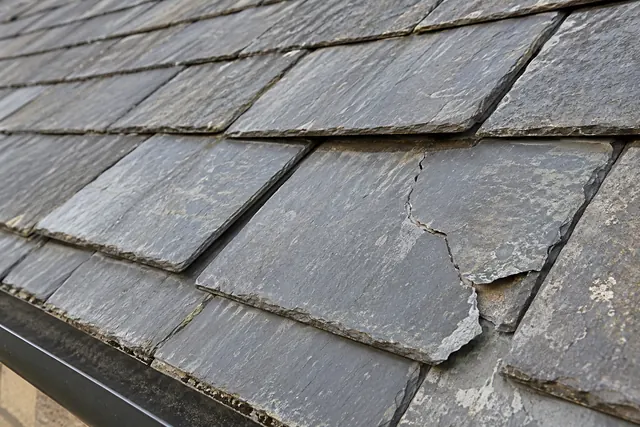
Slate is durable, but it is not indestructible. Storm damage is the most obvious cause of trouble. High winds can lift slates, crack them, or pull them off entirely. Sometimes the damage is not visible from the ground. A single missing slate can let water soak into the roof battens and the roofing felt below. Over time, that moisture rots the timber and rusts the nails, which leads to more slates slipping.
Another common issue is the natural weathering of the slates themselves. Even good quality slate will delaminate or become friable after many decades. In Bearsden and the surrounding areas, many houses were built in the early to mid-twentieth century, and their original slates are now reaching the end of their service life. When a roofer starts work on such a roof, they often find that several slates are already cracked or that the nail holes have enlarged. A proper assessment will involve tapping each slate and listening for the tell-tale dull sound of a broken piece.
Valley gutters are another frequent source of leaks. These are the channels where two roof slopes meet. They collect a lot of water, and if the metal lining or the slates around them are damaged, water can run straight into the roof space. Repairing a valley gutter usually means removing the slates on both sides, replacing the felt and the metal lining, and then reinstating the slates. It is a bigger job than replacing a single slate, but it is far less expensive than dealing with years of hidden rot.
Materials and Tools for the Job
A professional roofer working on slate roof repairs will bring a specific set of tools and materials. You should expect to see a slate cutter for trimming slates to size. Unlike a normal tile cutter, a slate cutter uses a sharp blade or a guillotine action to split the stone cleanly. The roofer will also have a roofing hammer with a sharp edge on the head for dressing the slate, and of course a harness kit for working safely at height. Safety is not optional on a pitched slate roof. The surface is slippery when wet, and the slope is often steep.
For fixing the slates, copper nails are the traditional choice because they do not rust. Zinc strips are sometimes used in a method called "nail-less" fixing, where the strip is bent over the top edge of the slate. Both methods work well if installed correctly. The roofer will also carry a respirator mask because cutting slate produces silica dust, which is harmful to breathe. A good contractor will wear one without being asked.
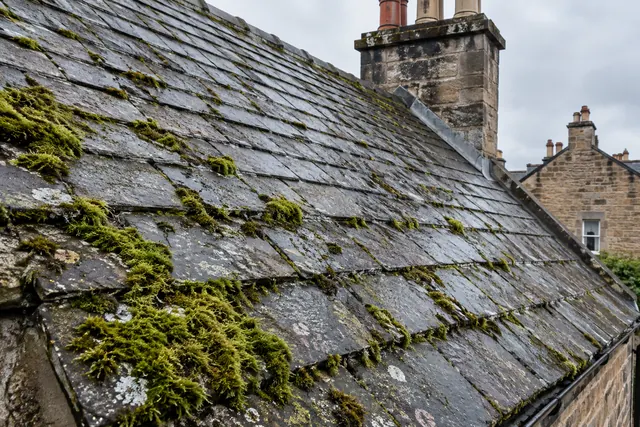
The mortar mix used for pointing along the ridge or around the chimney needs to be the right consistency and colour. A stiff mix that is too rich in cement will crack as the roof moves with temperature changes. A lime-based mortar is often better for older roofs and heritage buildings, because it allows the structure to breathe and flex slightly. In listed buildings, you may be required by building regulations to match the original materials exactly. That is another reason to choose a roofer who understands traditional methods, not just modern quick fixes.
When to Call a Roofer and What to Ask
If you notice a damp patch on a ceiling, or if you can see daylight through a gap in the slates from the loft, do not wait. The longer water gets in, the more damage it does to the roof structure and the insulation. For storm damage, a temporary cover with a tarpaulin can hold things for a few days, but it is not a permanent solution. Call a local roofing contractor who specialises in slate work. In Bearsden and Glasgow, there are several experienced companies, but not all of them have the same level of skill with natural slate.
When you speak to a roofer, ask them how they will match the new slates to your existing ones. Slate can vary in colour and texture even within the same quarry. A good roofer will source recycled slates or choose new ones that are a close visual match. You should also ask about the condition of the roofing felt and the roof battens underneath. If those are rotten, replacing just the slates will not solve the underlying problem.
A reputable roofer will give you a written quote that lists the work to be done, the materials, and the timeline. They will also be registered with a recognised trade body and carry their own liability insurance. For slate roof repairs, do not accept a quote that seems too cheap. Quality slate and skilled labour cost money, and a low price usually means corners will be cut somewhere.
Long-Term Maintenance and Prevention
Most slate roofs need a professional inspection every five to ten years, and after any major storm. The roofer will check the slates, the lead flashing, the valley gutters, and the pointing. They will also look at the condition of the zinc strips or copper nails. Catching a loose nail or a cracked slate early can prevent a much larger repair bill later.
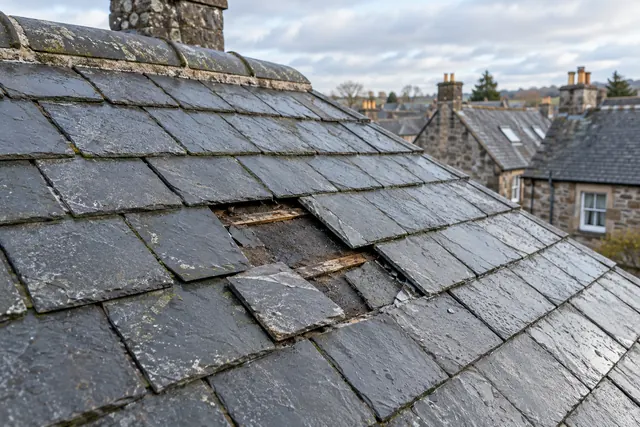
If you live in a period property or a listed building, it is worth keeping a record of any repairs. Future owners or the local conservation officer may want to see that the work was done with appropriate materials. Regular maintenance also keeps the roof looking good, which adds to the value of the house.
Slate roof repairs are not something to tackle on your own. The combination of working at height, handling heavy stone, and needing to keep the building watertight means this is a job for a trained professional. The good news is that a properly repaired slate roof will last for decades. With the right care, your roof can outlast the house itself.